
Meet Ari Ryn: The Creative Head Behind Wonderful Half
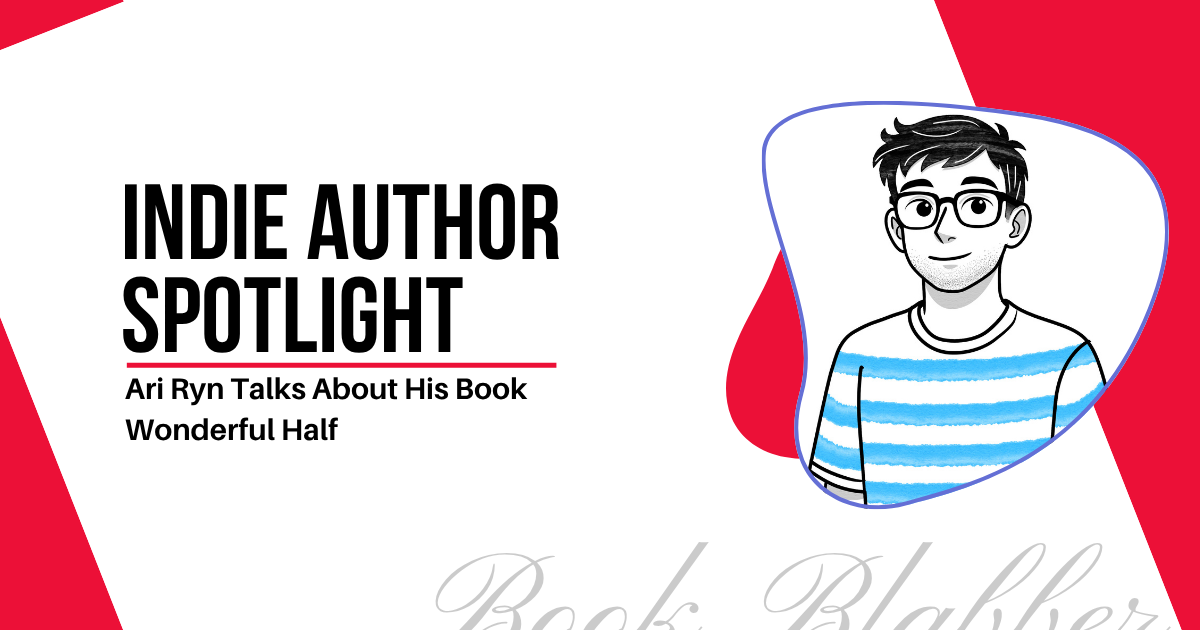
What does it take to turn a personal experience into a story that resonates with strangers across the globe? Today, I’m catching up with Ari Ryn, the voice behind Wonderful Half. We’re moving beyond the plot to discuss the messy, beautiful reality of the writing process. He takes us behind the scenes of his journey.
If you've ever wondered how an author builds a world that feels both personal and unsettlingly real, this one’s for you. This article is all about how the story came to be, the struggles of indie publishing, and the lessons Ari learned along the way.
Let’s dive in!
1. Tell us a little about yourself.
About your book and who you are when not writing. Any fun facts or quirks we should know?
Oh, well, that’s a tough one. I would say I’m a little socially awkward. I’m always busy with work or doing chores around the house. In my free time, I mostly like to go out for a walk, if the weather allows, somewhere in nature or in a park. That’s my favourite thing to do. Walking. Outside. Imagine that, right? I also like to read in the evenings before bed, be lazy at the weekend and watch anime, or go down the rabbit hole and research some random thing that has nothing to do with my life for hours.
Writing is a hobby that I picked back up a year ago when I started working on Wonderful Half. It’s a book about the desire for connection and understanding that peeks inside the mind of Kentaro and lets the reader experience one sweaty summer in Japan with him. And get to know Akira and Naoki, too.
2. Your day sounds fun. Working on any new story?
Yeah, I’m already working on another novel. I’m only on Chapter Two, but I’m taking things slow and focusing more on research and refining the plot in my head. I had already thought of the outline while working on Wonderful Half, but it’s not a series or anything.
It explores a different set of challenges and issues through an adult Kentaro, a decade or so later. Readers won’t need to have read the first book to understand the second. It’s more like two standalone books featuring the same characters.
3. Awesome, pitch Wonderful Half in one or two sentences.
Japan, 2000. It’s summer. You’re 14 again and sweating buckets. On top of that, the ice cream is bad, there’s that weird new boy you keep crossing paths with until you somehow become friends and get to know each other’s most disturbing thoughts and life-shattering trauma.
4. And what kind of readers would love this book?
I think readers who like slow-paced, character-driven stories and value authenticity are the ones who would enjoy it the most. Or people who would love a cosy summer story about friendship, with disturbing and gloomy patches in between.
5. Okayyy, now, let’s get a little personal. What’s the story behind your story?
Here is where things get a little sad.
One day, I read about a boy who threw himself in front of a train, and it really shook me. I kept wondering what must’ve been going through his head to do something like that, how unwanted and alone he must’ve felt. The more I thought about it, the more I realised that I already knew because I had experienced it myself growing up. That kid and I were not that different.
When I was a teen in the country where I grew up, struggling with mental health was often dismissed as being weak or seeking attention. I was told to pull myself together and grow up, which does not help. In Japan, in my opinion, there was, and still is to some extent, a stigma around mental health, even if things have been changing for the better over the last decade or so. When I was 14, there were no books I could think of that had characters going through something similar to what I was experiencing. I mean, there are probably plenty, they’re just hard to find. So I decided to write the story I needed to read back then.
I did not plan for the book to go the way it did, but after spending so much time writing about the boys, I couldn’t bring myself to turn it into something tragic. Instead, it turned out to be a story about finding the people you belong with.
6. Yeah, that stigma is common in India, too. Looking back, is there something you wish someone had told your 14-year-old self that you tried to convey through this book?
I would tell that shy, lonely kid spending the summer holidays reading in his room that the wonderful thing he is waiting for does come around, and it turns out to be far better than he ever hoped.
7. Wow. Every book has that one scene or character that sticks with the author. What’s yours?
The scene that I love most from the book is the memory of the trip to the beach and the red lighthouse. In it, Kentaro is truly happy and carefree, and I love that version of him. The funny thing is that the scene was not originally planned to be in the book. I kind of wrote it as a writing exercise. One day, I came across Kawaii Yuto singing a song from Kiki’s Delivery Service or Laputa: Castle in the Sky. I’m not sure which one it was; he sings both.
I got nostalgic and later went looking for other songs from Studio Ghibli films to listen to, and ‘Sayonara no Natsu’ came up. It’s from From Up on Poppy Hill, one of my favourite Ghibli films. Whoever composed that song must’ve been a genius, because the music matches the rhythm of waves washing ashore on a hazy summer day perfectly.
And that’s how the scene was born: listening to that song.
8. Hehehe, love this. Which is your most favourite Ghibli film? Do you see yourself writing a spin-off novel inspired by a Ghibli character?
Well, it’s not one but three Ghibli films that I like the most: From Up on Poppy Hill, Whisper of the Heart, and Only Yesterday. Those are my favourites. They’re not as imaginative and grand as Spirited Away, Laputa: Castle in the Sky, or Howl’s Moving Castle. Those are the kinds of fantasy stories the studio is best known for. They’re more ordinary, everyday stories that focus on human connections. Maybe that’s why I like them so much.
And I certainly don’t see myself writing a spin-off novel inspired by a Ghibli character. Miyazaki has his own distinctive style of expression, and I don’t believe it can be replicated. Plus, there are the copyrights and all that, haha.
9. Ohkay, back to Wonderful Half. What’s one weird or unexpected thing you Googled while writing this book?
How a bedroom door in Japan would end up having a lock.
It’s a tiny detail that probably no one would’ve paid attention to, but it kept bugging me. For the sake of the story, I needed the door to Kentaro’s room to have a lock, but the thing is that in all the places I’ve been to in Japan, there were no locks on the bedroom doors. It’s not a very common thing to have, especially in a one-bedroom flat in an old, cheap apartment complex built in the 1960s.
I needed to find a plausible explanation for why his door would have a lock, so I dug into building practices from the end of the twentieth century, building materials, renovations, maintenance, and so on. This is a prime example of what I meant earlier about going down the rabbit hole researching a topic.
In the end, I decided that the building owner would’ve been a cheapskate and used a leftover door from another building when renovating the one Kentaro lives in.
10. Hehehe, wild. What part of this book gave you the hardest time?
Writing the transitions. Often, I already have a particular scene living in my head, and I can’t wait to write it down, but first, I need to do the setup that leads to it. I can’t just drop random things into the story without tying them together logically. So, I had to be patient and stop myself from rushing through those parts.
11. Yeah, transitions are definitely tough. How has the indie publishing ride been for you?
It was definitely a learning experience. There was so much stuff I needed to do before publishing. Applying for an ISBN, setting up a Goodreads page, making an author website, finding an editor, properly formatting the book for print and EPUB standards, and so on… It’s a lot.
And nobody tells you that after publishing, you have to put effort into marketing your book. I kind of expected to set up a low-key ad campaign and leave it be, existing in the world, but you really have to make an effort to find readers, too.
12. I agree, it’s a full-time job. How has the reader response been so far for your book?
Well, it’s been quiet, I have to admit. It’s really hard to position the book and find the right readers. The surprising part is that readers on NetGalley and LibraryThing seem to connect with it much more strongly than I expected, and really seem to love the friendship dynamics and the boys. My original intention was for the book to be a trauma story that offered a glimpse inside the mind of a troubled kid, to make the adult reader understand that it is not a cry for attention or something to simply grow out of. But I think the book ended up becoming more than that.
I deliberately kept the language simple to keep it authentic to Kentaro and appropriate for his age. It makes the novel read as YA, especially in the opening chapter, but I think it is hard to classify it as YA. The pacing is slow, Kentaro spends a lot of time in his head reflecting, and there are no major plot twists driving the story forward. It’s mostly Kentaro observing things and making conclusions, and they are not always correct. The reader is left to connect the dots for themselves.
So I guess it sits closer to literary fiction than YA. But it’s definitely coming of age. Cosy and gloomy at the same time. It sits in a grey area, which makes it harder to market, as it sends mixed signals. I think I still need to do a better job of finding the right niche and getting it in front of the readers who would enjoy that kind of story.
The main hurdle at the moment is that there are no reviews on Amazon. Without social proof on the platform, people are not sure what to make of it. I hope that will change in the future. Surprisingly, the paperback is more popular than the ebook.
13. Yeah, social proof is essential. What’s one piece of author advice you wish someone had given you?
Don’t compare yourself to others. Write because you love writing. Don’t do it to chase the market. Unless you want to make a career out of it, though, I suspect it’s gruelling work. I can’t imagine writing three or four books a year and having to market them all. I’d just end up hating it.
Do what you enjoy, put your best effort into it, make it professional, and maybe people will find it and love it, or maybe not. There are no guarantees, but at least you’ll know you did your best.
14. Totally! Now, where can readers find you and your book?
Wonderful Half is available on Amazon for purchase and through Kindle Unlimited.
You can follow me on Instagram and Threads at @ariryn_author or drop me a line through my website at ariryn.com.
If the book sounds like something you’d be interested in reading, please do check it out. And if you enjoy it, leave a review. It’s a great way to support a novice indie author.
PS… What’s your go-to writing snack or ritual?
It’s rather cliché, but I usually make a cup of peppermint tea before I start a writing session, and it gets cold by the time I get to it. Usually, my partner scolds me and tells me I need to drink it and stay hydrated.
When I’m writing, I get so sucked into it that I forget about everything else.
And that’s a wrap.
Want to see more indie author stories? Stay tuned for more interviews…


Comments